
The Long Wait for UTOPIA
“The art world has a real issue with making things overly conceptual, too complicated and using wanky jargon…It alienates people.”
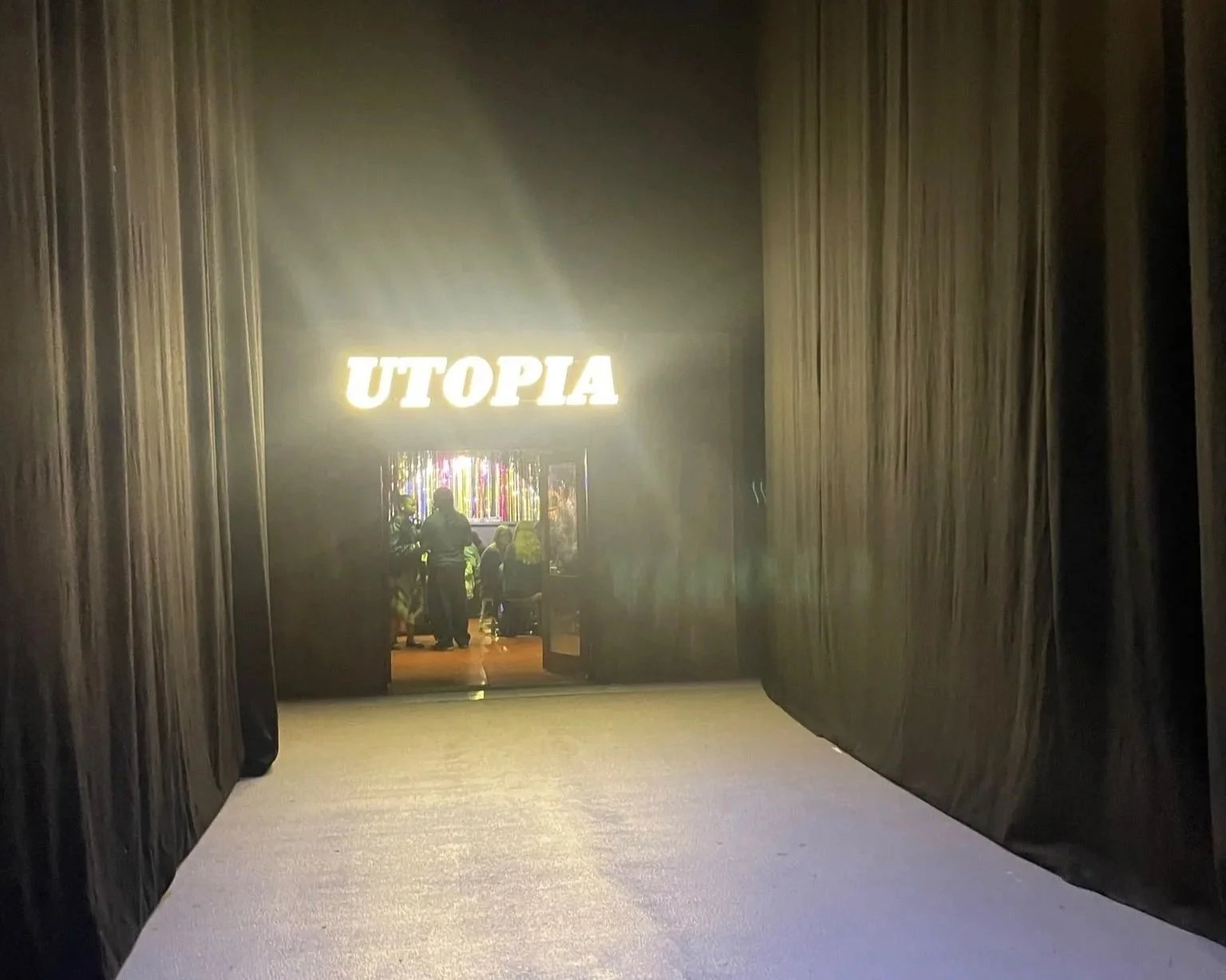
UTOPIA emerges through the darkness
Three quarters of working men's clubs have closed over the past 50 years. Originating in the mid 19th century, these organisations began as a centre for industrial communities, a social space for workers to engage in a variety of political, educational, or recreational activities. As membership was expanded over the next century and a half, they have morphed into not only a place to drink but a unique social center and a focus of community life. A space perhaps most often known for their cheap drinks and friendly atmosphere.
However, despite an offering that is rapidly lacking throughout the country, many working men's clubs have struggled with falling membership and a lack of funds, stemming in large part by an outdated image and little interest from younger demographics. Membership has free fallen from 4 million to under 1 million today. It is in this context that artist Trackie Mcleod opened UTOPIA, a three-day exhibition at Manchester’s multipurpose cultural venue Factory International.
UTOPIA is described as an interactive space exploring concepts of nostalgia, class and the changing landscape of Manchester inside ‘an art installation that happens to be a pub’.
The installation is marketed in part as a tonic for a world where human connection has become increasingly scarce. Visitors are invited to drink and chat in a fabricated space erected inside Factory International’s exhibition hall. Into the evenings the venue plays host to separately ticketed live music events and a talk exploring pubs as ‘third spaces’ within a community. The space itself takes inspiration from the Glaswegian social clubs frequented by the artist in his youth.
McLeod is an artist that trades in nostalgia. A recent exhibition, Soft Play, explores the liminal space between childhood and teenhood where children’s play collides with the exploration of adult actions like drinking and smoking. Similarly, in UTOPIA the artist has sought to recreate the Glaswegian 1980’s working men’s clubs and the wood panelled fabric of the space, with the help of additional artworks such as a Louis Vuitton embossed high-vis jacket and a framed print of the Sky TV menu, is the vehicle for this.
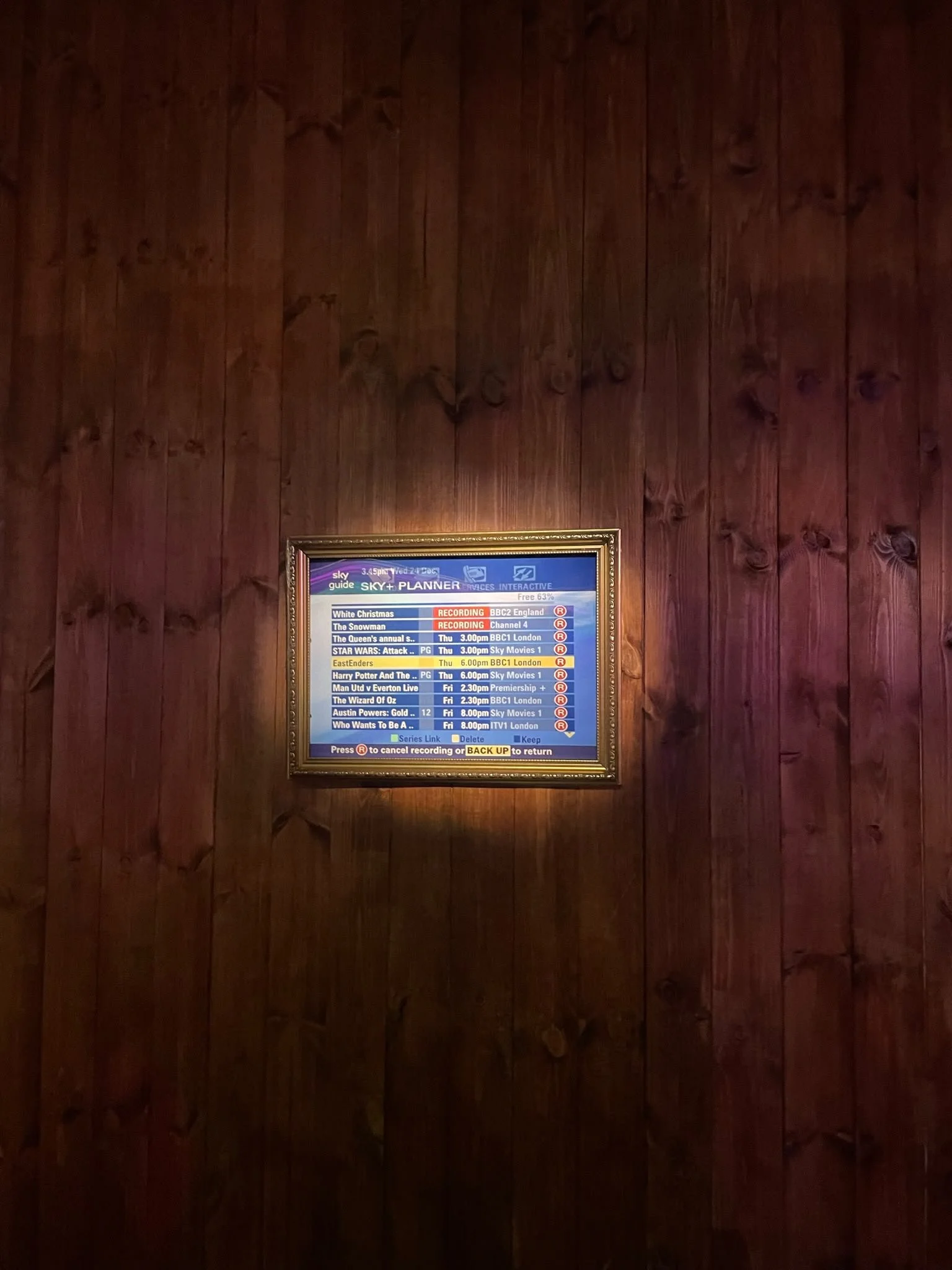
Sky TV in a gilded frame.
Inside, the space certainly feels like a pub. It has pints and pies like a pub does. It has slightly tacky floors like a pub does. Visitors can sit down with a pint after lurking near a family who look like they’re leaving one of the sacred few tables, like they might at a pub.
However, sitting in the space created by UTOPIA, drinking a pint and chatting with friends round a sticky table, you are struck with the inevitable feeling of being both inside and out. Beyond the warm walls of UTOPIA is an empty void. And you do not feel like you are inside a pub.
Instead the space McLeod has created functions like set dressing. We are given a story of class prepackaged in our own common preconceptions. The panelled walls and tiled ceiling convey a narrative to us that we are invited to take at face value; within the space the Northern working class come predefined through common motifs - a pie counter here, a dart board plastered with Margaret Thatcher's face there. Nothing that might otherwise challenge preconceptions is in evidence. The result is conceptually barren and aesthetically bland; the microwave meal of art. There were branded pint glasses, though by the time we arrived they had all been nicked by previous visitors, perhaps the most immersive part of the evening.
Perhaps the assumption McLeod and Factory International made was that in return for being presented with a pub, visitors will perform the act of community within the space. A sense of bon ami that often only occurs after one too many pints will prevail and the social club will be reborn. Partially this is successful, the pub is certainly bustling, but it is hard to ignore the underlying spectacle at play. Without challenging art to distress their preconceptions about class and community, the visitors are unable to engage meaningfully with the space. Many patrons simply rove the installation, artistic types pose by the fruit machine with their pint, or take selfies in the artist’s queer-themed pub mirrors. The voices McLeod claims to champion are lost in the novelty of a pub transported into a gallery.
Arguably however, the largest transgression happens before you can even enter the space. Anyone who went to UTOPIA would have their experience first defined by the immense and badly organised queue that preceded the installation.
Upon opening, the venue filled immediately and in doing so created something of a class system for those still outside its doors. There were those lucky enough to be stood in the ‘official’ queue on the stairs, and for everyone still in the lobby, too unorganised and unlucky, were left to form a scrum that was created and disbanded at the disjointed whim of the stewards.
There seemed to be no time limit on how long visitors could spend in the installation, and therefore space became the exhibition’s ultimate value; access was by no means guaranteed even after hours of waiting. We queued for two hours to get into the space, during which two of our group opted instead to visit a real pub. There was no indication what disabled visitors, who may not be able to stand for an hour plus, may do if they wished to see the installation.
Additionally, those in the queue were also able to watch the artist McLeod come down periodically to let friends up past the line and directly into the space, violating that most British of concerns, the inherent fairness of a queue system. Such acts had the ironic potential to foster hostility among visitors who have come to a space that lauds community, where even the beer mats encourage you to talk to your neighbours. Those who finally entered the space would be more unwilling to leave, to let the next group in, focused instead on getting the reward for their time investment.
Though undoubtedly an issue with the venue and not the artist’s work - the promise of a free pint was always certain to draw a crowd - there would be no escaping into the fantasy after such an experience. Certainly no members of a real working men’s club would be willing to queue for multiple hours to enter their own pub. The scarcity of access lent the space ultimate value, arguably further alienating UTOPIA from its own contextual roots.
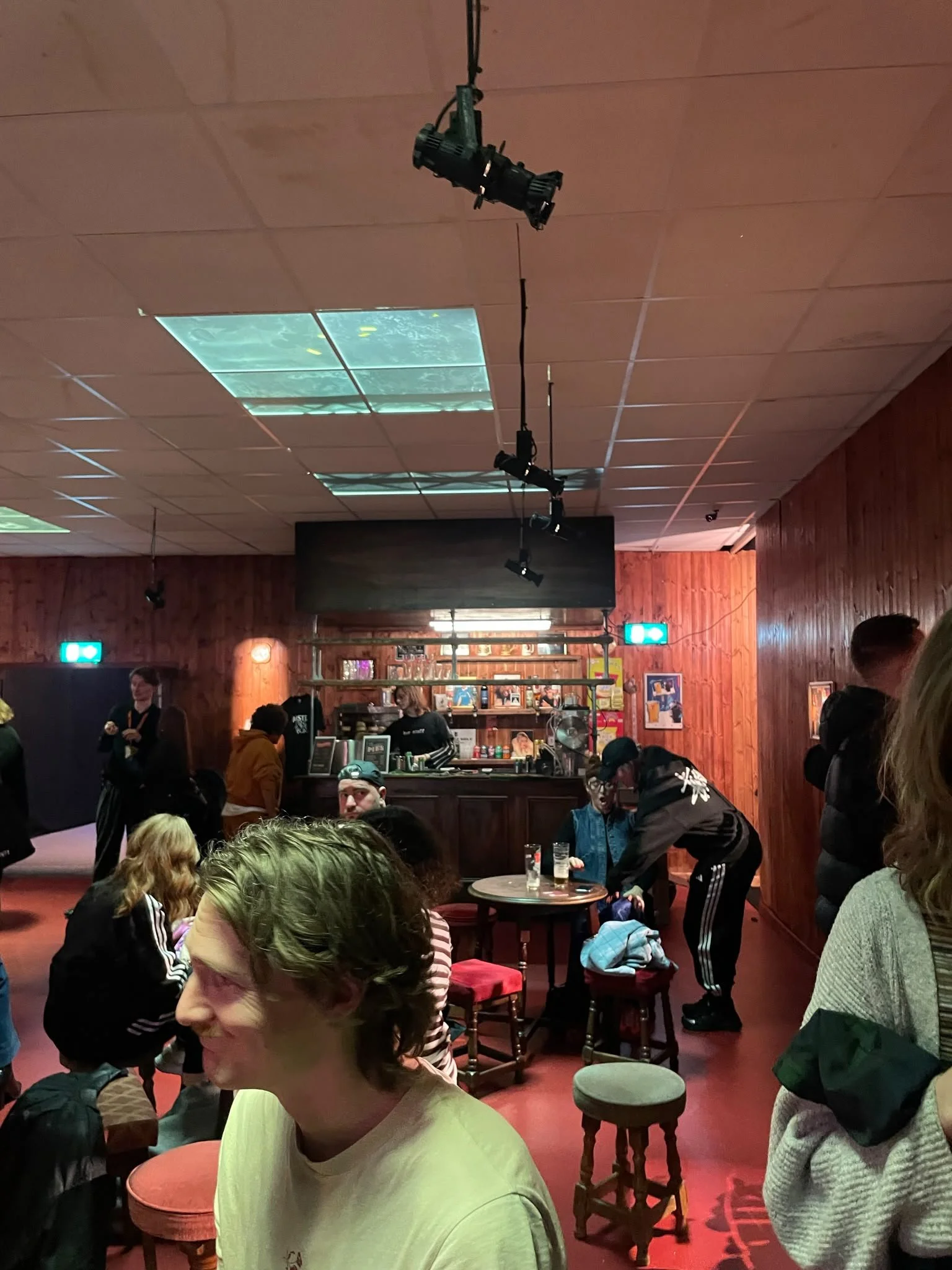
The bar at UTOPIA, serving pints and pies
This is only one in a myriad of ways Mcleod’s work dances around its own context, refusing to engage meaningfully with its own provocations. Even the choice to set the social club in the context of the late 80’s seems a way to avoid confronting how the digital age has contributed to dwindling physical social spaces in favour of online chatrooms, at odds with even the extraneous artwork within the space. Nothing feels more indicative of this than the inclusion of Margaret Thatcher on a dartboard alongside contemporary political figures like tech mogul and political worm Elon Musk rather than Reform UK leader and architect of Brexit, multi-millionaire and twat Nigel Farage.
Well-known for using a facade of working class pub culture to bolster his stock with the voters up and down the red wall, Farage goads his political rivals on social media by smugly inviting them to ‘enjoy a few beers with the lads’. That he is not represented here is significant. He is the proverbial ghost at the wedding. Perhaps no other contemporary political figure looms so large in the public conscience as synonymous with working man’s clubs, whose clientele are often associated heavily with Reform’s core demographic.
McLeod wants to create a space that is welcoming and familiar, but in doing so he ignores the complexity of the pub ecosystem. Social clubs and pubs can often be places where the familiar is taken to extremes. They are not neutral spaces, and treatment within them can often depend on familiarity and homogeneity, particularly in smaller communities. A pub at its core is a community hub, and that community can be for good and ill. A criticism of social clubs by the left is that it is a breeding ground for intolerance. Progressives on the left often subject those in the working class to derision themselves, accusing them of being ‘too stupid’ to see through these insidious public figures who manipulate their socioeconomic position for votes.
Working class culture is more often than ever being wielded as a political weapon. The irony being that those who brandish it most effectively, Farage and US president Donald Trump, have no interest in representing the people they lean on most heavily for support.
To create a space for all as McLeod does here is admirable rejection of this view, reusing a space that is often seen as a hotbed of prejudice in popular media as a space to incorporate diverse communities and queer art could be subversive, but without engagement with what makes this so we are left wondering why build this space at all? Perhaps McLeod is unable or unwilling to see past his own veneration of these spaces from his youth and any nuance that could come from examining and the good and the bad of social clubs as a social space is unrealised.
Case in point, UTOPIA promises that the artist would be pulling pints behind the bar, but at time of visit he could be found sat chatting in a tight-knit circle of friends like any other visitor. Having McLeod behind the bar may have represented a subversion, a space where the artist serves you, a chance at familiarity between vendor and patron. It is yet another missed opportunity. Though admittedly, McLeod has certainly mimicked the familiar pub regular with astonishing accuracy.
Manchester is a canny choice for this kind of exhibit, indeed the first working men’s club in the UK opened in 1857 in Stockport, a town on the edge of Greater Manchester. It is a city with deeply entrenched mythology, a heartland of the industrial North that is synonymous with the working men’s clubs of old. This image persists despite large amounts of gentrification pricing long-time residents out of the city centre. UTOPIA theoretically addresses this dissonance, but choosing Factory International as its host only lends further irony to the project.
The multi-million pound venue is still a relatively new addition to the city centre, occupying the space where Granada tv studios once stood. Opening in 2023, what at first glance may seem to be the city’s answer to the Tate Modern’s Turbine Hall, it is sold as a cultural venue supporting all aspects of the medium, from theatre to pop music to contemporary art. It is also a space for spectacle, the size of the exhibition space promising art experienced on a grand scale.
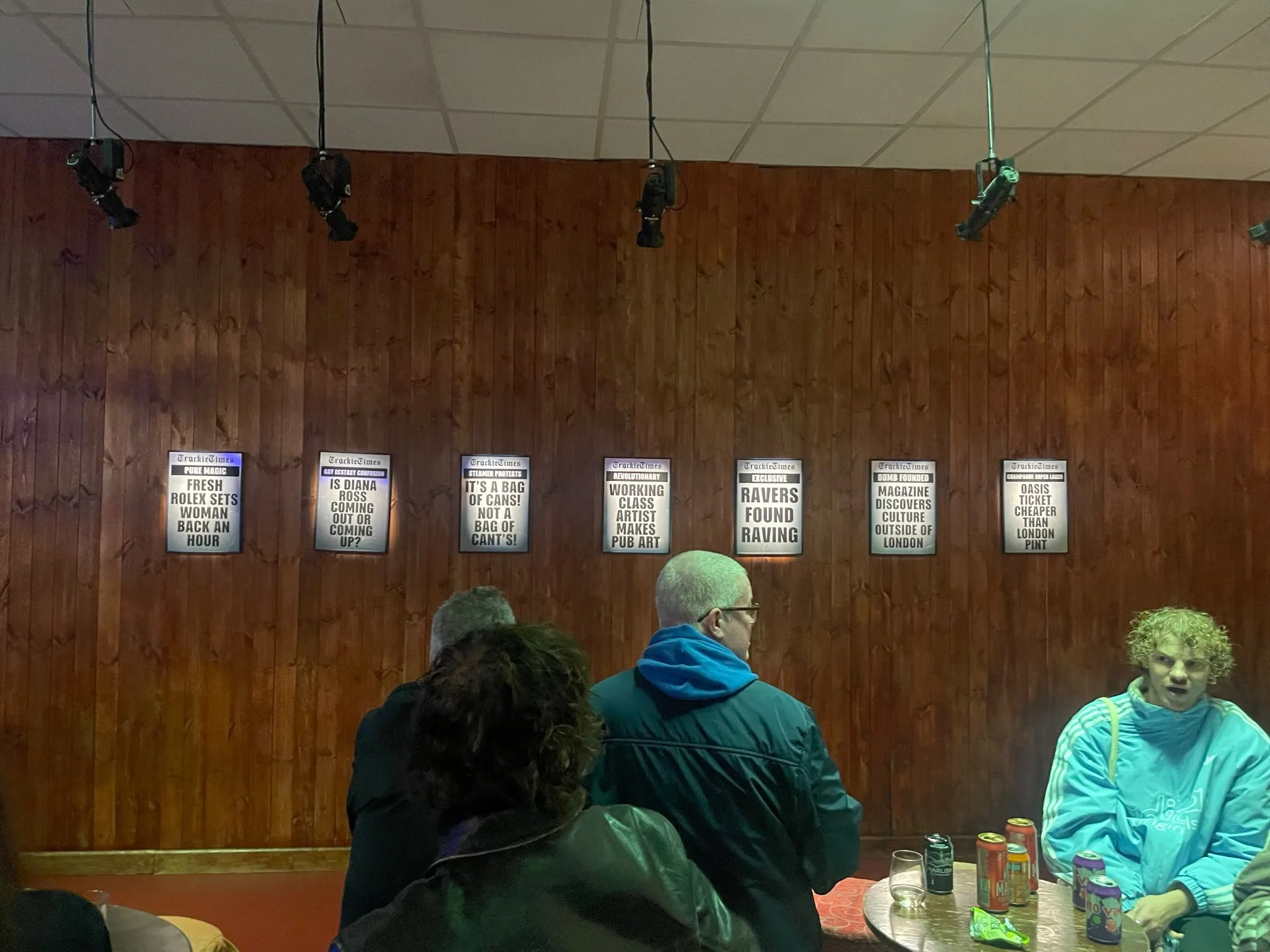
Mock headlines draw on 80’s and Manchester tropes
This emphasis on immersive spectacle is in many ways indicative of a wider problem in Manchester. The hollowing out of the creative scene and gentrification more widely throughout the city, resulting in a glass-and-chrome homogeny that is worlds away from the city’s long-held stone-mill ‘gritty’ image. Factory International itself is part of a larger renewal effort aimed at the waterside area of St John’s, likely hoping to pull in members of a creative class that would find the venue’s offering appealing and the high rents in the area manageable.
Such a venue also shouts loud enough to drown out calls for smaller, grass-roots venues in the city that smaller artists who may well have frequented the same social clubs as McLeod in their youth would flock to in times gone by; choosing instead to pull in internationally renowned artists rather than foster a symbiotic relationship with local creatives. The imposing metal structure takes up space culturally as well as physically and the prohibitively high prices charged for most exhibitions - often exceeding £20 for a standard ticket - seems like a joke that hasn’t landed.
Within the hangar-like exhibition hall, UTOPIA is both figuratively and literally swallowed by the venue, and one is left to wonder why, in a city where real working men’s clubs and social spaces are struggling to remain afloat, is the artist and a cultural venue like Factory International not instead using this as an opportunity to create connections with these very communities? You can’t ignore what it means to operate a working man’s club inside a venue like Factory International, and in this vein the project feels most of all like a missed opportunity to engage fully with these spaces it purports to champion.
Though a vital space in their communities, many working men’s clubs are the preserve of older generations and struggle to remain visible to a younger crowd while their current demographic continues aging out. The rising cost of living also affects the very customers that such spaces rely on for revenue the most, and many venues are buckling under the pressure. Despite the myriad of signs hanging around this space, UTOPIA ignores this particular writing on the wall.
However, there are examples of successful interventions into these spaces by local artists throughout Manchester. Recently, the pop up broadcast DJ’s Nite School, who had previously operated out of a vacant pawn shop in the now demolished Stretford Mall, this year teamed up with Metro’s Sports & Social Club to use the space. The social club has been serving the Stretford community since 1906, but in recent years has struggled financially. Nite School, set up a bit later in 2017, have acted as creative fungi, taking over dead and dying spaces and pumping life back in by spotlighting local artists, DJs, small businesses and community voices and growing the creative backbone of less affluent areas by highlighting their innate cultural value. The collaboration resulted in Metro's Gala, an all day event that was part of a wider offering of events for the town’s annual festival Stretfest. As a result of the event the club received 17 new annual membership sign ups alongside a packed dance floor on the day of.
Such collaborations are meetings of the mind, a symbiotic relationship between established venues and creative projects, reusing spaces inclusively and imaginatively as part of a larger regeneration project. They redefine what community is and what it can be. Directly confronting the popular stereotype of such clubs as stuck in the past and drawing in new demographics who may have otherwise felt unwelcome or othered in these spaces, encouraging familiarity for younger generations in spaces that traditionally skew older.
UTOPIA appears to have no such concerns for that kind of immersion, rather than reaching out to the very establishments it mimics it chooses instead to operate in an echo chamber populated by the artistic elite. That descriptions of the installation specifically note how the exhibition in part is a response to how the community spaces are disappearing or moving online makes the choice here even more baffling. Occupied by the artistic elite demographic, the trappings of a working class seem doomed to inhabit the space only as background noise, easily ignored in the clamour of the bar. McLeod’s work is more evocative of a staff lock-in on the disused set of Phoenix Nights than a regeneration of any kind.
Going into the exhibition you might wonder what it means to create a fully functional pub in this space, and more pertinently what does it mean to do so inside a venue like Factory International. UTOPIA, in my opinion, fails to examine these spaces in a way that makes it successful art
What has been erected in the exhibition hall by McLeod feels more like a painting that perhaps the artist or host realises. Instead of a living space we confront a rigid tableau, a diorama perhaps, of what a pub looks like when it is a room erected in a large gallery space, but not what it is. No complexity either pertaining to such a space, or the social tapestry of those who traditionally occupy it is present. Inside it may be warm and busy, but outside it is dark, quiet and cold, and the UTOPIA seems smaller than ever.
A word of warning: You can’t have your pint and drink it too.