
Rival Reviews: Mompesson House
A room with a view, exploring the stately halls of Mompesson House.
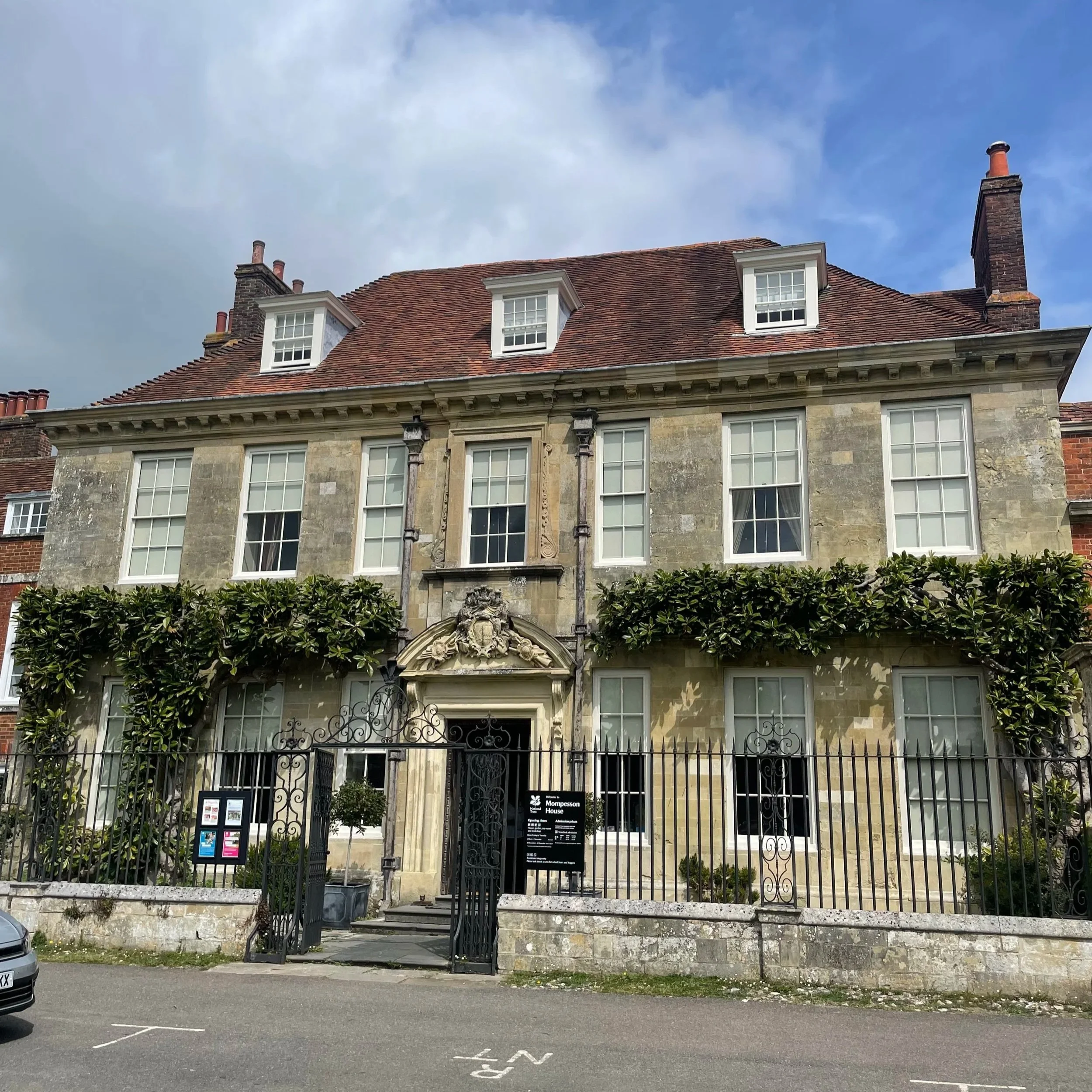
The author’s Barbie Dream house
The sun is shining in Salisbury as we walk past the imposing shades of the medieval cathedral and over a small green surrounded by houses that make you wish you had made different life choices that would have resulted in a job with a higher salary. This is my second time here in this historic city visiting a boyfriend, and my second walking past this building, though I confess at first glance the house we are now here to see only wandered through my field of vision as an object of domestic envy as I was frogmarched towards the big, big church.
I am wiser now. A brief google search (I don’t do AI) through the plethora of historic sites around Wiltshire revealed Mompesson House not as a private residence to be marvelled from afar but a National Trust entity to be marvelled at closely while poking through all the rooms and looking under the furniture, and so we are back.
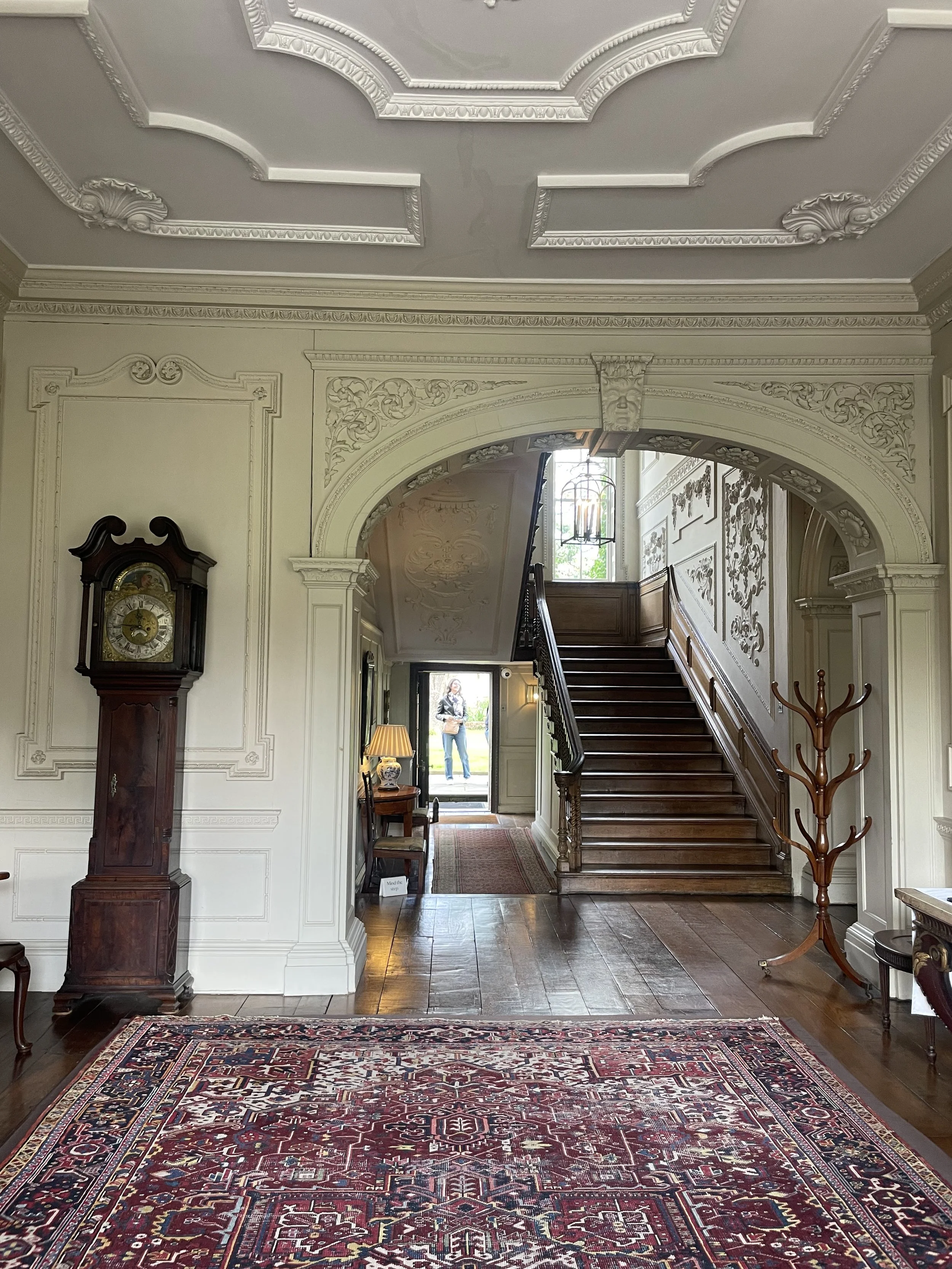
The dollhouse charm at full blast
The house is annoyingly beautiful. It is built in the Queen Anne style, referring to the baroque architecture popular during the monarch’s rule and almost exclusively used in domestic builds, usually townhouses or manors. Think of a typical dollhouse and what you are picturing is not far off. Building materials were carefully contrasted, brick frontages will be offset with a lighter, highly decorated stone around the windows and doors, though not here on Mompesson. Particular attributes include exposed brick, hipped roofs, dormer windows, sash windows and cornices. Like many things British the individual components of this style are cherry picked from other aspects of European design. The symmetry of the houses refers back to those championed by revered architect Inigo Jones adoption of Ancient Roman ideologies; the ornamentation is French and the windows are Dutch. The whole is something charming and dignified. It oozes class and wealth but it does not shout. Perfect for the sensibilities of the 18th century upper classes.
But let’s not start there, let’s instead look back a bit farther through the mists of time, and two miles away to Old Sarum, where the first Cathedral used to stand. It was located inside an Iron Age fort, but the move was necessitated by deteriorating conditions at the original site and in 1220 work began on building the present cathedral. While Salisbury began to grow up around the site. Cathedral Close, where Mompesson now stands became the place for the Bishops and Clergy of the Cathedral to make a home with a short commute.
By the 17th century the city had become the largest in the whole of Wiltshire, and an established Wiltshire clan, the Mompesson family, who had resided in the small village of Bathampton since the 15th century, clearly wanted in on that action. Tom Mompesson the elder signed a lease securing a 40-year lease on the north side of Chorister's Green in 1635 from the dean of Salisbury Cathedral and subsequently built a large property with a hall and ten other rooms at his fashionable new address. Not for long however as he died in 1640.
The house as it now stands most likely started construction during the tenure of his son, helpfully also named Tom Mompesson. The family was a little ahead of the curve it seemed. By the time work was begun Cathedral Close had pivoted from the preserve of members of the clergy to an aspirational address for the local gentry. Such close proximity prompted the usual competition and most residences were rebuilt or updated to current fashions for the time.
It was this Thomas’ son, Charles, who oversaw the majority of the work to the current building after his father died in 1701. You will see his initials and the date 1701 carved into the hopper heads (the technical term for a container installed at the top of a gutter downpipe to collect and manage rainwater) and the Mompesson and Longueville family’s coat of arms are carved into a cartouche (a technical term for a tablet or drawing representing a scroll with rolled-up ends, used ornamentally or bearing an inscription) above the front door to commemorate the marriage of Charles to Elizabeth Longueville in 1703. Charles clearly wanted to leave his mark, but like his grandfather before him it wasn’t to last. After his death in 1714 the Mompesson residency on the house came to an end.
From 1714 Charles’ widow Elizabeth and her father William continued the tenancy on the house; her brother, another Charles, seemingly also moved in after their fathers death around 1723. Despite changing owndership, renovations to the house continued during this time, notably ornate plasterwork and a large oak staircase that imposes on visitors to this day. The house was originally turned to Charles’ son upon his death in 1750, though when Elizabeth died only a year later, she stipulated in her will that it pass to her friend ‘Mr Thomas Hayter of Salisbury’ when Charles the younger died. In actuality it appears Thomas bought Charles’ son out of his inheritance and the Hayter family remained at Mompesson House for two generations. After this it became in ownership of the Portman family in 1798.
The recently widowed Ann Portman moved to Mompesson House with her daughters, Ann Mary, Henrietta and Wyndham. Henrietta eventually married, but Anne Mary and Wyndham never did and continued to reside at the house even after their mother’s death in 1814. Henrietta sold the house in 1846 after her sister’s deaths. We will return to them later.
The next in line to live in the house were the Townsend family, who had occupied Hungerford Chantry, directly next door to Mompesson. They had clearly been eyeing up the property. Their daughter Baraba, was the house's longest resident and resided at the property until her death in 1939.
After serving briefly as the Bishop’s house in the inter-War period, the house was then sold again in 1952 to Denis Martineau, a London-based architect looking for a weekend home in the country. He bought it under the condition that upon his death it would be donated to the National Trust. They had to wait a while. It was finally inherited in 1975 and the Trust spent the next two years tastefully redecorating the property into its originally Georgian style and furnishing the empty house before opening its doors to the public in 1977.
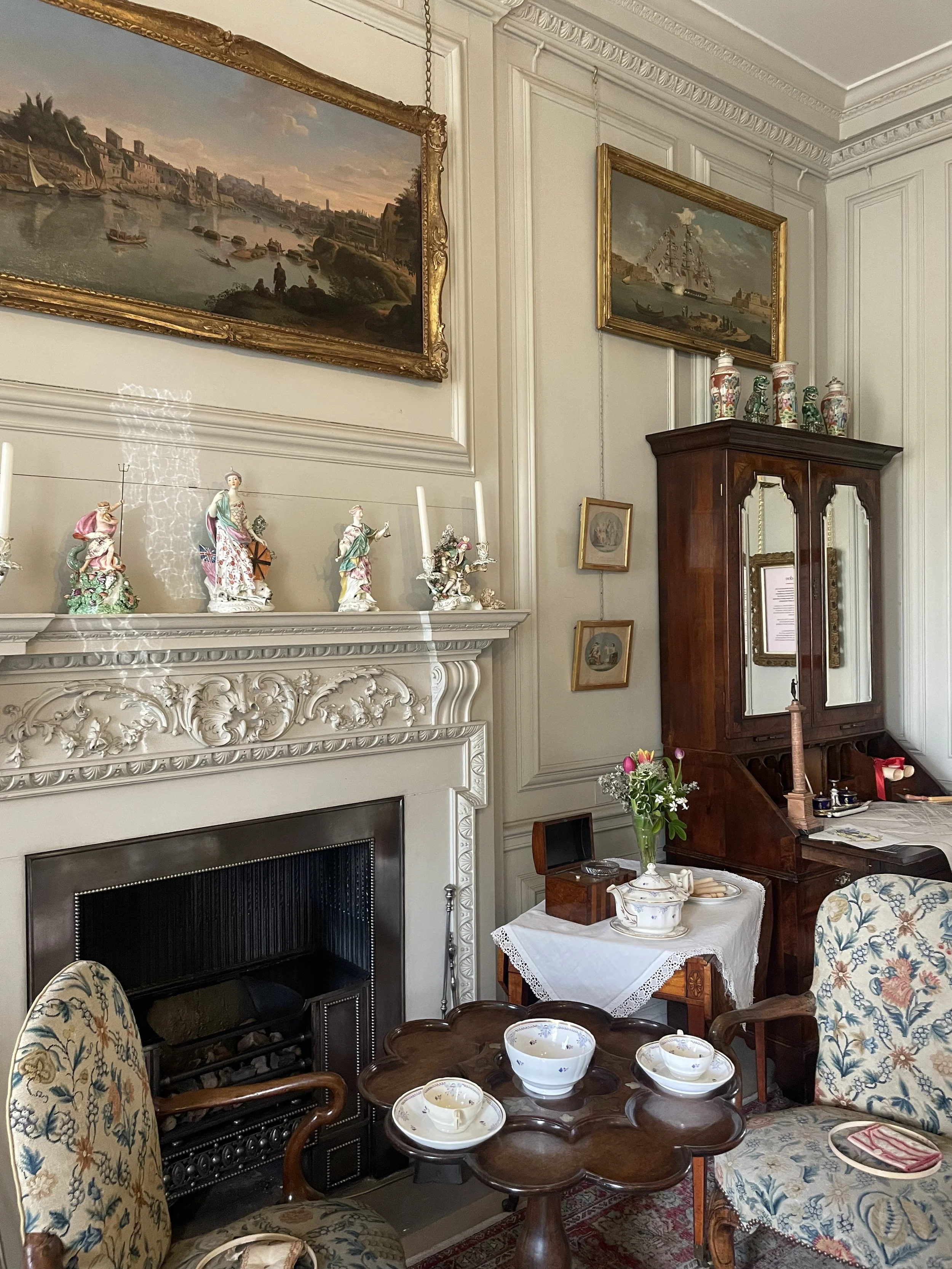
The tools of the trade for eligible Regency women
These days the Mompesson goes through something of a redecoration every couple of years. Though keeping the Georgian interiors (and one presumes the heavier items of furniture) the house is resituated into a new era with the appropriate fixtures and furnishings. One may walk in next year and find the drawing room as if Denis Martineau has just stepped into the garden to get some air, a radio on the table and a newspaper laid out across a chair. On this particular day in Salisbury however we visit the house as it had been during the residency of the Portman sisters.
As such the house is laid out as it would have been lived in by three unmarried women during the early 18th century. The house is laid out to reflect the social season of the Regency era from Spring to Winter when families would host and women were expected to find partners.
This was not a good time to be an unmarried woman.
Mompesson was thus presented to show the ways in which upper class women were expected to navigate the trials of the age. It was unseemly to take work so women of means would be expected to fill their upbringing of a fairly limited formal education with skills and hobbies that made them particularly admirable to suitors, one of the only ways to ensure financial safety.
Such hobbies were referred to as ‘accomplishments’ and would include the ability to draw, sing, dance, play an instrument or speak a language. In Austen’s Pride and Prejudice, the dishy Mr Darcey also alludes to women being extensively well-read and pleasing in both gait and tone as extra accomplishments that made them deserve the word, but he is a bit of a snob still at this point so don’t take him too seriously. It is a snapshot nevertheless into the relentless expectations of the young women of the era. It is noted that often after these all-singing, all-dancing women were able to smugly parade their abilities at parties in front of others to attract men, after marriage these accomplishments would be rejected if serious passion was not a motivating factor.
In the drawing room we were introduced to some of these pastimes. A pianoforte sits in a corner; the instrument became particularly popular with the upper classes after its invention in 1700 as it was a suitable alternative to the much more bulky grand piano, this and harp playing were both considered appropriately ladylike for young women and they would often be prevailed upon to perform at evening gatherings. No pressure.
Another telling prop in Mompesson is a small pile of needlework left unfinished on a table. In this era learning to sew was essential for women’s education and you would be shocked by the sheer amount of it going on. Not only was it a key part of domestic education before handy inventions like the sewing machine, but it passed the hours at home, fulfilling a need much like scrolling on TikTok does now.
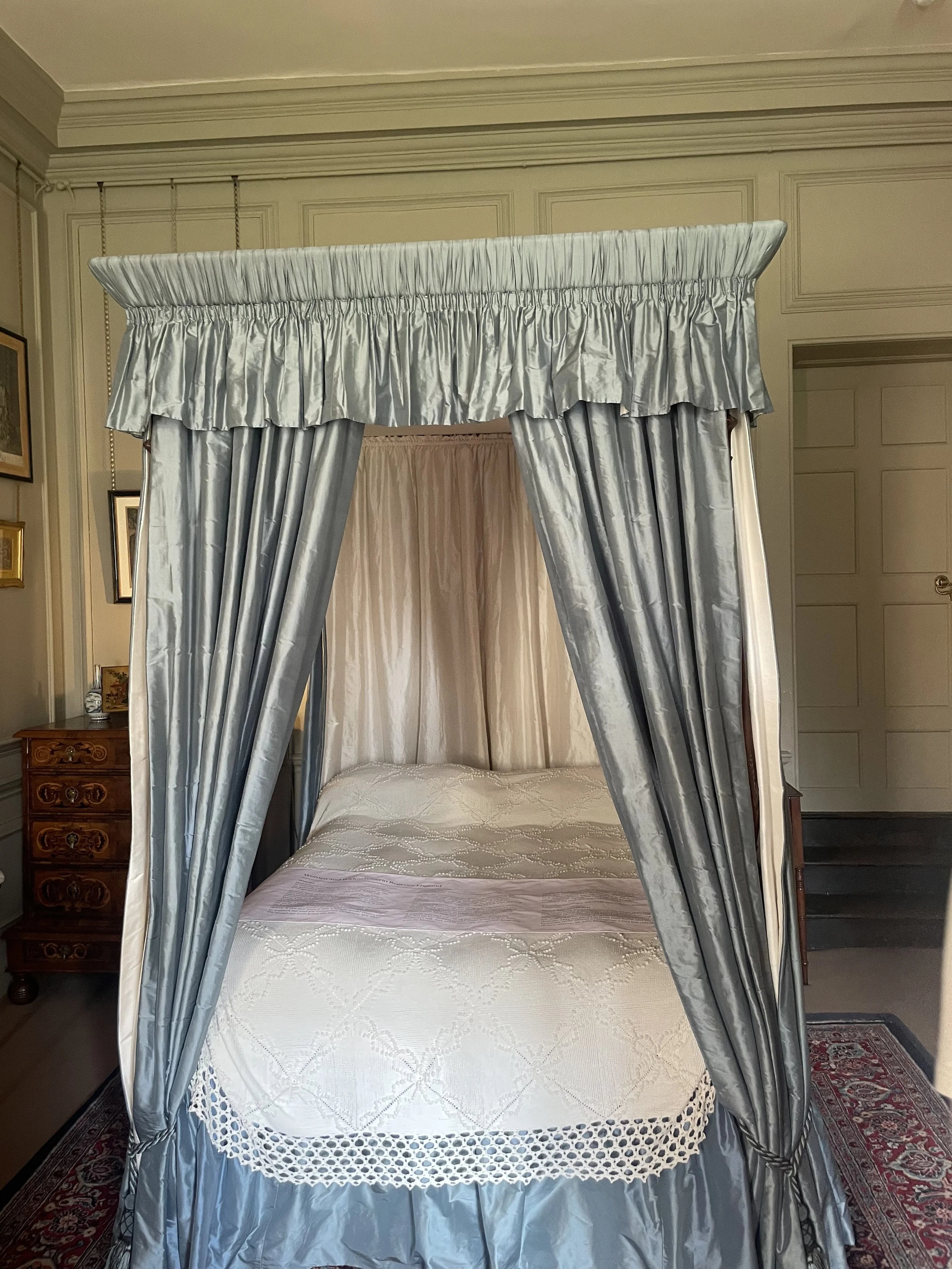
The marriage bed wasn’t always an assured future…
In other parts of the house we learn about the balls attended during the era, often key social events for local communities; or how and what time various meals were served. One of the most telling rooms however is the bedroom upstairs, where we learn about what awaited women who were not able to secure a marriage, and what happened when they became widowed.
Interestingly this has particular poignancy at Mompesson. In 1995 the house was featured in the film adaptation of Jane Austen’s Sense and Sensibility, which follows the fortunes of the Dashwood family matriarch and three sisters after the death of their husband and father. John Dashwood had an older son from a first marriage, and with little care for his step-mother and half-sisters, they were forced out of their estate and into a modest cottage in Derbyshire with no financial support. Mompesson was used as a stand-in for a sumptuous London townhouse owned by a family friend where the girls stayed for a short while.
The Dashwood family are an unwitting parable of the real-life Portman Family. Elinor, Marianne and Margaret are played by Ann Mary, Henrietta and Wyndham Portman, but unlike the charming Dashwood sisters, only Henrietta was destined to marry and leave the family home.
You see, Regency society organized itself around marriage and family. Adults were identified by their place, or lack thereof, in a family unit. Therefore we know a fair bit about what happened to women destined to spinsterhood. We also know who they were. Women were typically identified in tax or judicial records by their marital status (spinsters, wives and widows) whereas men were always identified by their occupation or social status, which says it all really.
Remaining unmarred in this era was considered unnatural, weird, spooky. It was also extremely difficult, without a fortune sufficient to live on, women would have to find work or rely on their male relatives for support, as in Sense and Sensibility. You may remember that upper class women had limited job prospects, focusing on accomplishments rather than marketable skills, so their options were usually either governess (often required more education than some women had and was also not an enviable position), or lady’s companion (better - providing company of a wealthy, noble women, this paid without sacrificing social status).
Even marriage was no guarantee, if you were to marry, your silly husband might take it upon himself to die, and then where would you be? Back at square one usually, once again relying on male inheritors to see you through - let’s hope you had a brother or a son that likes you. This was the situation that Anne Portman and her daughters found themselves in at Mompesson House.
Outside the lush garden is blooming, and there is time to glimpse the small stone outhouse that used to be the only source of relief for the house’s occupants. There is a gazebo that is probably not historically accurate and a small cafe selling hot drinks which I nose at but do not purchase from. It is easy to imagine spending lazy summer regency afternoons lounging on the lawn, now overlooked by a sixties Lego block of a building, which probably wasn’t there back then.
And this is where our tour ends. My boyfriend was never really into it and he had resorted to sending me selfies from every reflective surface on the property; I wanted to see Salisbury Museum before I ended up in a historic pub garden; and I was unspeakably jealous that I didn’t live there myself.
Lunch?
I had lunch before I came, which is always a wise choice when visiting a National Trust property.
Is the cafe in the kitchens or the stables?
There’s barely a cafe at the site! You can take tea and a small offering of cakes and snacks in the former garden summer house. I thought it looked cute but they didn’t appear to offer prosecco like they sometimes do at National Trust sites and that was more what I was in the mood for.
Can I take my kids?
Yes! Particularly this year where there is a whole room dedicated to Georgian childhood. They’ll love the creepy rocking horse and lead lined soldiers if they look up from their iPad at any point.
Can I take my dogs?
Inside the townhouse? No. Inside the garden? Also no? I didn’t check but the only entrance to the property is through the house so probably not. The garden is so small however I doubt your pooch would be impressed with you if you did.
Walks?
Again, this a townhouse so there are no walks to be had unless you count a brisk 26 second stroll down the garden path. You are in the centre of historic Salisbury though, why not walk along the high street for a coffee, or explore the many, many, many pubs.
Well, what did you think?
There is a give and take with structuring your historic property around a certain era of time. On one hand, there is a certain disparity with the asides to other parts of Mompesson’s varied history. The ghosts of other residents hang over the Portman family’s narrative and while volunteers are knowledgeable on all former residents, the effect has the potential to be confusing for visitors.
However, Mompesson House is much smaller than the typical country pile that National Trust is known for and I appreciate the difference in approach. Perhaps the roles for women in this time intrigued me so much because of my own place in the world and affection for books like Sense and Sensibility. The interpretation is intriguing, thoughtful and tight - all positive attributes in historical narrative which as a subject is prone to bloat. I feel it matches the refined pared back style of the house itself. This is a bit of a National Trust deepcut; there is after all a very famous heritage building across the square from the property that rather demands attention, but for the better part of an hour you will be charmed.